Getting Started
Catalogue Delivery Service (CDS)
The Catalogue Delivery Service (CDS) is Tuned Global's solution for clients who want to run their own music platform using our catalogue. Rather than building on top of Tuned Global's white label apps, advanceAPIs or web player. The client takes ownership of the experience, using our catalogue feed as the foundation while building their own applications or apis on top of it.
This is the right path if you're building a bespoke music experience, your own apps, search, playlisting, user accounts, and more. Tuned Global handles the ingestion, standardisation, and enrichment of catalogue metadata, along with the storage of audio files and artwork. You handle everything your users see and interact with.
As part of your agreement, you send us play activity data so that Tuned Global can produce accurate end-of-month reports for rights holders and labels.
Where a client prefers to not manage any APIs or metadata, Tuned Global has an Advanced API (aAPI) solution that manages these requirements. Please discuss this requirement directly with your Tuned Global account executive.
Integration Overview
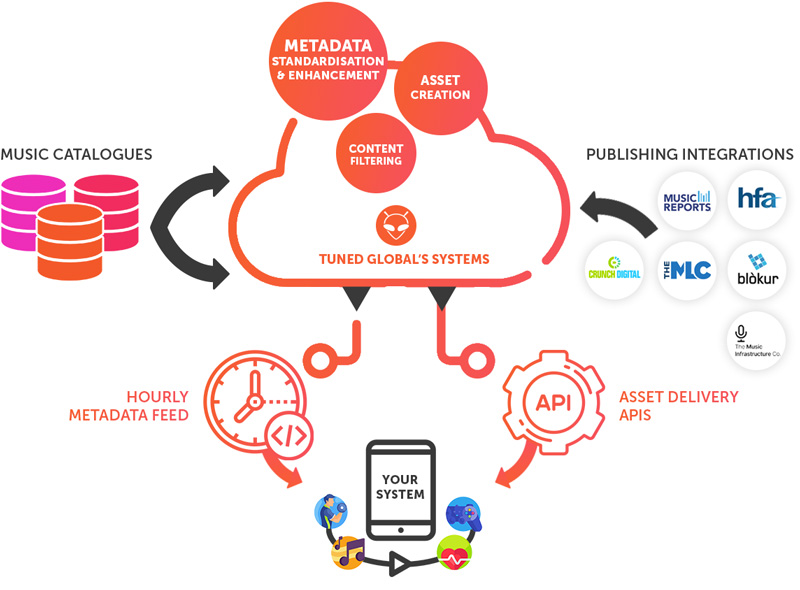
You connect to our catalogue delivery system once via a shared data feed, pull down your catalogue metadata and assets, and then report back every time a track is played. That's it.
The feed setup is a one-time configuration. Metadata ingestion is your team reading and storing our catalogue data. Asset downloads happen on-demand as users request content. Play logging is the mechanism that drives both label reporting and your monthly billing, so it's important to get right.
Step-by-Step Integration
Step 1: Feed Setup
Configure the JSON feed that Tuned Global will write your catalogue JSON data to. There are three options:
Option | Who configures it | What you provide |
TG-hosted S3 | Tuned Global | Nothing, we share the bucket details, access key, and secret key. |
Client S3 | Client | YouCreate an S3 bucket in your AWS account and provide us the bucket details and access keys so our CDS can write JSON files to it |
Your SFTP | Client | Share SFTP credentials so our system can export JSON files to your server |
Evaluation / trial? You can download a sample JSON file here — it contains 200 albums from a test catalogue. No feed setup required to get started.
Step 2: Metadata Ingestion
Once the feed is live, begin consuming the JSON files from S3 or SFTP and persisting the metadata in your system.
Key things to handle at this stage:
- Rights enforcement — apply territory, platform, and label restrictions accurately as you ingest. This is a label requirement and errors here are difficult to correct downstream.
- Asset references — the JSON contains references to images and audio assets. Use the Asset APIs to download these separately.
Step 3: Asset Delivery (Songs & Images)
When a user requests a track or artwork, call the relevant API to retrieve the file:
- Stream API — downloads the audio asset
- Image API — downloads album or track artwork
Important — implicit fetch logging: Every call to the Stream API automatically generates a fetch log on our side. These logs are aggregated at month-end to calculate the per-play fees payable to Tuned Global. No additional action is needed from you here, but you should be aware that each asset download is a billable event.
Step 4: Play Logging (LogPlay API)
Call the LogPlay API every time a track is streamed by an end user.
This is separate from the fetch log in Step 3:
Log type | Who creates it | Purpose |
Fetch log (Step 3) | Created automatically by our system on each Stream API call | TG's Monthly billing to you |
Play log (Step 4) | Sent explicitly by your system on each user play event | Label reporting and royalty distribution |
Both are required. The fetch log alone is not sufficient for label reporting, you must send the explicit LogPlay event on every user-initiated stream.
Once you're familiar with the integration steps above, head to the Integration Models section to determine which model best fits your use case and infrastructure requirements.


On this page
- Getting Started